
History of agriculture book list
 Before I launch directly into the history of
agriculture, I want to spend a post citing my sources. Nearly all
of the information I'll discuss later comes from three books, each of
which is a fun read and chock full of fascinating information I didn't
have time to include in this lunchtime series. The books also
provide more in depth evidence for each of the assertions I'll make in
the following posts --- I've glossed over certain bits of data to keep
the posts short, sweet, and to the point. To paraphrase an old
folk song, if you want anymore you can read it yourself.
Before I launch directly into the history of
agriculture, I want to spend a post citing my sources. Nearly all
of the information I'll discuss later comes from three books, each of
which is a fun read and chock full of fascinating information I didn't
have time to include in this lunchtime series. The books also
provide more in depth evidence for each of the assertions I'll make in
the following posts --- I've glossed over certain bits of data to keep
the posts short, sweet, and to the point. To paraphrase an old
folk song, if you want anymore you can read it yourself.
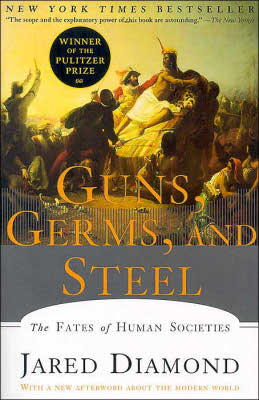
Diamond, Jared.
1997. Guns,
Germs, and Steel.
W.W. Norton & Company, New York.
Leonard, Jonathon
Norton. 1974. The First
Farmers.
Littlehampton Book Services Ltd.
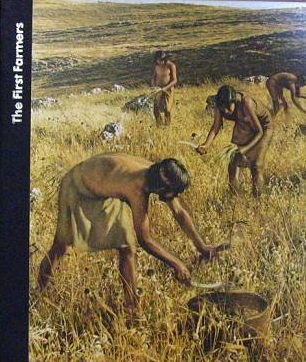 The only flaw in The First Farmers
is the book's age. Presumably, some of the individual facts are a
bit out of date, but the book is still a very good introduction to the
advent of farming, focusing primarily on the Fertile Crescent.
It's easy to read and full of beautiful photos, but at the same time is
clearly based on specific scientific studies.
The only flaw in The First Farmers
is the book's age. Presumably, some of the individual facts are a
bit out of date, but the book is still a very good introduction to the
advent of farming, focusing primarily on the Fertile Crescent.
It's easy to read and full of beautiful photos, but at the same time is
clearly based on specific scientific studies.
Manning, Richard.
2004. Against
the Grain: How Agriculture Has Hijacked Civilization. North Point Press,
New York.
This post is part of our History of Agriculture lunchtime series.
Read all of the entries:
|
Or explore more posts by date or by subject.
About us: Anna Hess and Mark Hamilton spent over a decade living self-sufficiently in the mountains of Virginia before moving north to start over from scratch in the foothills of Ohio. They've experimented with permaculture, no-till gardening, trailersteading, home-based microbusinesses and much more, writing about their adventures in both blogs and books.
Want to be notified when new comments are posted on this page? Click on the RSS button after you add a comment to subscribe to the comment feed, or simply check the box beside "email replies to me" while writing your comment.
Check out Ishmael by Daniel Quinn. Fascinating analysis of agriculture and it's relationship to the garden of eden and cain and abel myths from the bible. You'll love it. Looking forward to checking out your blog- want to homestead-
Hmm, I'm adding "guns, germs and steel" to my reading list.
Even while it's not mainly concerned with agriculture, I've found Bill Bryson's "A short history of nearly everything" a very interesting overview of general science history.
The scholarly consensus on Diamond (not that you're obligated to care, I just thought you might be interested), is that he over-simplified his argument to sell lots of books. Which, in fact, he did -- sell lots of books, that is -- so maybe it's just sour grapes from historians whose books sell 3 copies. He also touched off an absolute wave of other popular macro-histories and commodity histories that look at the implications of one idea or object or phenomenon on world history (sugar, salt, tea, etc.). This trend ran alongside popular histories like "How the Scots Saved Civilization" or "How the British Navy Shaped the World," etc. -- all perhaps overly deterministic, although some certain more so than others. That's probably my biggest objection to Diamond also, and I think he doesn't sufficiently consider the role of human agency and culture. But I think he's fun to read.
The idea of the macrohistory came out of the French Annales school. The most famous is probably Braudel's The Mediterranean. If you're interested in macrohistory / global systems / commodity histories, there's a texbook I like -- The Human Web by somebody or other McNeil and also Sweetness and Power by Sidney(?) Mintz about sugar and economic development and the plantation agricultural system.
Heather