Seed onion experiments
 I'm
bound and determined to grow
our onions from seed rather than sets
because it costs much less and the onions will store through the winter
rather than giving up the ghost in late fall. One year, I had a
beautiful harvest from seed, but the next two years I got just a
few small onions. So this spring, I decided to try out several
different methods to figure out the simplest way to grow onions
effectively from seed.
I'm
bound and determined to grow
our onions from seed rather than sets
because it costs much less and the onions will store through the winter
rather than giving up the ghost in late fall. One year, I had a
beautiful harvest from seed, but the next two years I got just a
few small onions. So this spring, I decided to try out several
different methods to figure out the simplest way to grow onions
effectively from seed.
Here are the six
"treatments" I used in my 2011 onion experiment:
- 1. Early start with biochar under a quick hoop --- Direct-seeded on February 18 into soil treated with biochar under a quick hoop
- 2. Early start under a quick hoop
--- Just like above, but no biochar
- 3. Transplant into quick hoop
late --- Started indoors in February, then transplanted into a
quick hoop on March 8
- 4. Transplant into bare soil late
--- Same as above, but transplanted into soil not covered by a quick
hoop
- 5. Direct seeded into quick hoop
late --- Started directly under a quick hoop on March 8
- 6. Direct seeded into bare soil late --- Started directly into bare soil on March 8
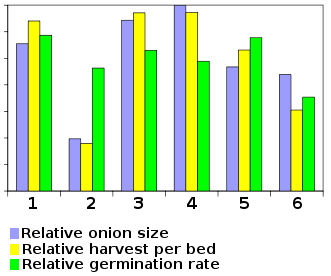 It
looks like the pros who tell you to start your onions inside and then
transplant them are right since treatments 3 and 4 are the clear
winners. (It doesn't seem to matter whether you transplant into a
quick hoop or not.) However, I was interested to see that if
you're lazy and don't like starting seeds inside, you can get results
nearly as good by direct-seeding into biochar-doctored soil under a
quick hoop at the same time you would have started your onions
inside.
My sample size for that treatment was extremely small (half of a bed),
so I'd hate to have anyone plan their entire year's onion harvest
around that observation, but it's definitely worth further
experimentation.
It
looks like the pros who tell you to start your onions inside and then
transplant them are right since treatments 3 and 4 are the clear
winners. (It doesn't seem to matter whether you transplant into a
quick hoop or not.) However, I was interested to see that if
you're lazy and don't like starting seeds inside, you can get results
nearly as good by direct-seeding into biochar-doctored soil under a
quick hoop at the same time you would have started your onions
inside.
My sample size for that treatment was extremely small (half of a bed),
so I'd hate to have anyone plan their entire year's onion harvest
around that observation, but it's definitely worth further
experimentation.
Or explore more posts by date or by subject.
About us: Anna Hess and Mark Hamilton spent over a decade living self-sufficiently in the mountains of Virginia before moving north to start over from scratch in the foothills of Ohio. They've experimented with permaculture, no-till gardening, trailersteading, home-based microbusinesses and much more, writing about their adventures in both blogs and books.
Want to be notified when new comments are posted on this page? Click on the RSS button after you add a comment to subscribe to the comment feed, or simply check the box beside "email replies to me" while writing your comment.
- Remove comment