No-till cover crop experiments
 Cover
crops were another innovation in 2010, doing double-duty as weed
suppressors and compost creators. My first goal was to find
varieties that like our clay soil and work well with no-till conditions
in zone 6 (i.e. they die over the winter or are easy to kill
by mowing), while
also building up as much organic matter in the soil as possible.
Meanwhile, I wanted to learn the best planting dates in order to grow
vegetables for as much of the year as possible and still find time to
slide in a cover crop planting.
Cover
crops were another innovation in 2010, doing double-duty as weed
suppressors and compost creators. My first goal was to find
varieties that like our clay soil and work well with no-till conditions
in zone 6 (i.e. they die over the winter or are easy to kill
by mowing), while
also building up as much organic matter in the soil as possible.
Meanwhile, I wanted to learn the best planting dates in order to grow
vegetables for as much of the year as possible and still find time to
slide in a cover crop planting.
 Here's a rundown on each
species I tried, with the caveat that the December snow coat prevented
a winter kill in several species that I suspect will still die out
before spring planting time. I also can't tell how much organic
matter has been added to the soil yet --- I'll try to remember to post
again when I delve into the dirt in each bed and notice the differences
between crops, but for now I'm just making guesses based on how much
vegetation is on the surface.
Here's a rundown on each
species I tried, with the caveat that the December snow coat prevented
a winter kill in several species that I suspect will still die out
before spring planting time. I also can't tell how much organic
matter has been added to the soil yet --- I'll try to remember to post
again when I delve into the dirt in each bed and notice the differences
between crops, but for now I'm just making guesses based on how much
vegetation is on the surface.
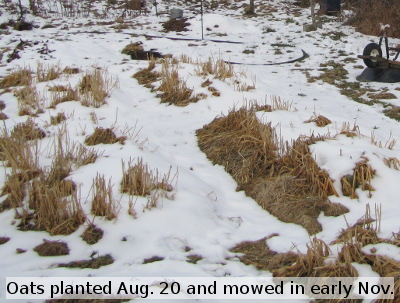
- Oats are currently my very favorite cover crop. They had no problem with our heavy clay soil and thrived even in the most water-logged beds, creating more top growth than any other cover crop we tried. Forage oats that I bought in a 50 pound bag at the feed store grew much better than hull-less oats, and the oats also seemed to need a top-dressing of compost to achieve maximum growth (which is worth it to me, although some people might wonder about using compost to grow compost.) The best planting period for oats in our garden seems to extend from the beginning of August (or possibly earlier?) through mid September --- the earliest ones bloomed two months later and had to be cut down, which is a bit of extra work but not a significant deterrent, while the late September and October planted oats just didn't get big enough to make it worth our while. The jury is still out on whether oats will winter kill, but mowing them is easy and weakens the plants enough that they die in even a moderate cold snap.
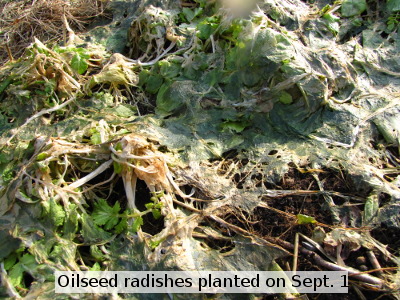 Oilseed radishes
are currently my second favorite cover crop, perhaps to be promoted to
favorite once I dig into the dirt --- they produce most of their
biomass below ground, so I can only guess at how their organic matter
production will stack up compared to oats. The only downside of
oilseed radishes is seed cost --- you can't buy the seeds at the feed
store, so you're stuck paying shipping and a higher price through
online suppliers (and they're new and trendy, so they cost a
lot.) Otherwise, though, the radishes do just as well as oats at
growing fast, putting up with clay soil and waterlogged conditions, and
outcompeting weeds. They are currently about two-thirds
winter-killed too, so I'm pretty sure I won't need to do any mowing to
wipe the radish cover crop out in the spring. As for planting
date, I planted radishes each week in September, and the earliest ones
definitely did better than the later ones, so I suspect their optimal
planting date is around the same as for oats, perhaps leaning a hair
toward earlier planting.
Oilseed radishes
are currently my second favorite cover crop, perhaps to be promoted to
favorite once I dig into the dirt --- they produce most of their
biomass below ground, so I can only guess at how their organic matter
production will stack up compared to oats. The only downside of
oilseed radishes is seed cost --- you can't buy the seeds at the feed
store, so you're stuck paying shipping and a higher price through
online suppliers (and they're new and trendy, so they cost a
lot.) Otherwise, though, the radishes do just as well as oats at
growing fast, putting up with clay soil and waterlogged conditions, and
outcompeting weeds. They are currently about two-thirds
winter-killed too, so I'm pretty sure I won't need to do any mowing to
wipe the radish cover crop out in the spring. As for planting
date, I planted radishes each week in September, and the earliest ones
definitely did better than the later ones, so I suspect their optimal
planting date is around the same as for oats, perhaps leaning a hair
toward earlier planting.
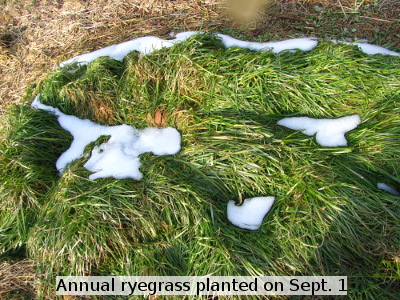 Annual ryegrass got off to a much
slower start than oats and oilseed radishes, but it seems to have kept
growing later in the year as well. When I went out to check on it
after the snow melted, I was surprised to find such a dense growth on
the ryegrass beds, and it's possible ryegrass might do as well as my
oats, especially when a bed opens up for cover crops later in the
year. Beds planted on September 1 did the best, but those planted
at the end of September did better than oats planted on neighboring
beds on the same day. The real question will be whether annual
ryegrass will winter kill since we're on the edge of its hardiness zone
and the beds are still bright green. If so, I'd plant annual
ryegrass on any bed that opens up between mid September and early
October.
Annual ryegrass got off to a much
slower start than oats and oilseed radishes, but it seems to have kept
growing later in the year as well. When I went out to check on it
after the snow melted, I was surprised to find such a dense growth on
the ryegrass beds, and it's possible ryegrass might do as well as my
oats, especially when a bed opens up for cover crops later in the
year. Beds planted on September 1 did the best, but those planted
at the end of September did better than oats planted on neighboring
beds on the same day. The real question will be whether annual
ryegrass will winter kill since we're on the edge of its hardiness zone
and the beds are still bright green. If so, I'd plant annual
ryegrass on any bed that opens up between mid September and early
October.
- Buckwheat was a
disappointment. The plants hated waterlogged clay soil, and even
where buckwheat seemed to grow well, very little biomass was left
behind. Buckwheat's main advantages are that it will grow fast,
reaching maturity in just a bit over a month, and that the crop is very
easy to mow-kill. I could envision planting buckwheat in a bed
that was being reserved for a late spring planting, but I don't think
it's worth using up prime fall beds with buckwheat.
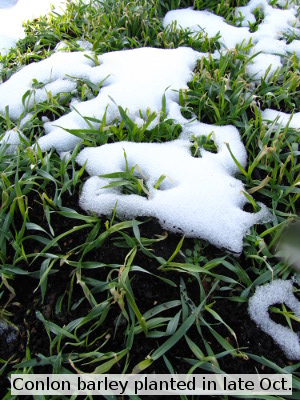 Barley
is still a big question mark. I planted it on a whim in late
October, and the plants didn't do much. Clearly, I'll have to try
again at a more realistic planting date.
Barley
is still a big question mark. I planted it on a whim in late
October, and the plants didn't do much. Clearly, I'll have to try
again at a more realistic planting date.
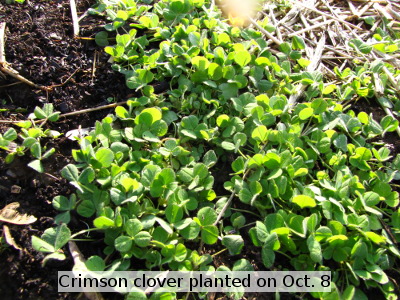
- Crimson Clover is also a
"who knows." I seeded clover in early October, and it came up and
produced its first set of true leaves before the cold weather hit, but
it's hard to tell anything else.
Looking beyond the
minutae, cover crops are a great addition to the garden, and I can't
imagine why it took me so long to come on board. (Well, I know
why --- I thought they were incompatible with no-till.) Cover
crops keep the soil from eroding and the food web alive in the fall
after the main garden is done, and it really
perks me up to look out at a sea of colors in November rather than at a
lot of dead stalks.
If I had to make only one recommendation to gardeners based on my 2010
vegetable garden experiments, it would be "Plant cover crops!"
This post is part of our 2010 experiments lunchtime series.
Read all of the entries:
|
Or explore more posts by date or by subject.
About us: Anna Hess and Mark Hamilton spent over a decade living self-sufficiently in the mountains of Virginia before moving north to start over from scratch in the foothills of Ohio. They've experimented with permaculture, no-till gardening, trailersteading, home-based microbusinesses and much more, writing about their adventures in both blogs and books.
Want to be notified when new comments are posted on this page? Click on the RSS button after you add a comment to subscribe to the comment feed, or simply check the box beside "email replies to me" while writing your comment.