How much land do we use to grow our own food?
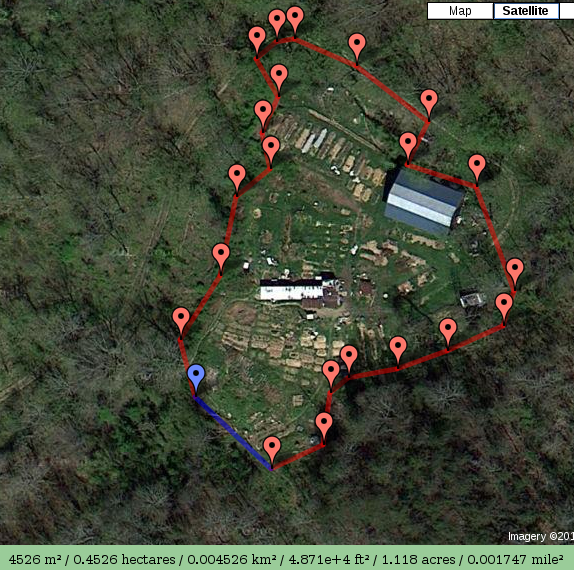
Thanks to google planimeter (and some awesome new maps,
updated this April!), I can answer Roland's
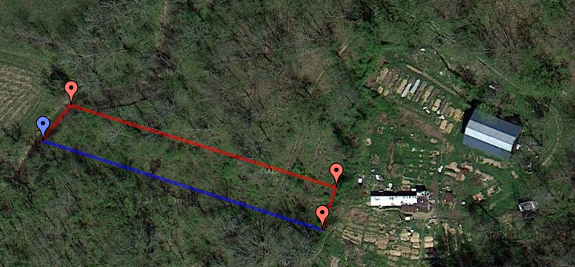
question about how much land we use to grow our own food. The map above shows
our total footprint on the land (minus our driveway, hunting area, and
woodlot, but including the house and barn) --- 1.118 acres.
Here's a breakdown of
the purposes to which we put that land:
| Use |
Acres |
Pastures:
|
0.1371 |
Vegetable gardens (including
strawberries and potatoes):
|
0.23275 |
Forest garden:
|
0.16535 |
Berries
|
0.04779 |
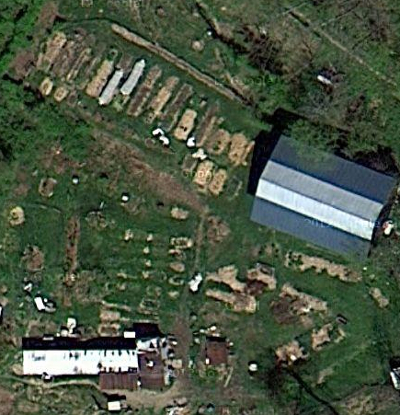 These
numbers only add up to about half the total acreage of our core
homestead because they don't include areas like the gully, trailer,
barn, woodshed, water tank, etc. That said, I have included
paths, both for people and for the golf cart.
These
numbers only add up to about half the total acreage of our core
homestead because they don't include areas like the gully, trailer,
barn, woodshed, water tank, etc. That said, I have included
paths, both for people and for the golf cart.I did some extra math, which I'll post on our chicken blog next week, and came to the conclusion that we outsource 0.36486 acres of growing land to the producers of our chicken feed, and perhaps that or a little more to the growers of our straw. Since you get both straw and grain from the same field, I'm not counting the straw figures into our land area. Nor am I counting the acreage on which the horses who give us our manure graze since manure is considered a waste product of their operation.
 We still buy a lot of fruit,
but that's because our orchard is young. I think our current forest garden
and berry patches will sate even my frugivorous appetite once
everything is mature. We will probably expand our berries a bit
more to fill in gaps, though.
We still buy a lot of fruit,
but that's because our orchard is young. I think our current forest garden
and berry patches will sate even my frugivorous appetite once
everything is mature. We will probably expand our berries a bit
more to fill in gaps, though.More relevantly, we buy red meat from a friend, and I don't have any data on how much land and grain she uses to produce that meat --- maybe another half acre? I'm not going to factor in the small amount of dairy products, flour, peanut butter, nuts, cocoa, sugar, and spices we get from the store --- that's beyond my math skills and we could do without if need be. (Except the chocolate -- can't do without that!)
So, to answer Roland's question, if we grew our own chicken feed but stopped eating everything else from the store, we'd be using just shy of half an acre (0.2 hectares) apiece to feed ourselves. This is the exact amount of arable land per person Roland estimates the world currently contains. I'm pretty sure whoever came up with those numbers didn't include steep grazing land in their arable land figures, so Mark could probably get away with adding in his red meat by raising sheep on the hillside. (Actually, I'm not so sure that any part of our property was included in the arable land estimate.)
Or explore more posts by date or by subject.
About us: Anna Hess and Mark Hamilton spent over a decade living self-sufficiently in the mountains of Virginia before moving north to start over from scratch in the foothills of Ohio. They've experimented with permaculture, no-till gardening, trailersteading, home-based microbusinesses and much more, writing about their adventures in both blogs and books.
Want to be notified when new comments are posted on this page? Click on the RSS button after you add a comment to subscribe to the comment feed, or simply check the box beside "email replies to me" while writing your comment.
If you had a portable chicken coop, would it be possible to make use of more woodland as foraging areas?
What's the red and blue rectangle in the last photo?
BeninMA --- The rectangle at the bottom is the powerline cut area in the floodplain. Since we can't let tall trees grow there, I figure it's a good spot to expand if we ever want to go beyond our core area.
I've considered a portable chicken coop to enlarge the chicken grazing area, but I think it's simpler to just have multiple coops for them. I do like the flock to sleep close to home so that our dog protects them... They seem to range a lot less of a distance from their coop compared to the hens in Joel Salatin's Eggmobile, which also makes me think that they're getting plenty of insects close to home in the winter, and that moving their home base might not make much of a difference. It's an interesting idea, though, and one we might experiment with if we enlarge the flock.
Anna - I was thinking that expanding the chickens' forage base could reduce your need to buy feed -- But I can see how it would be a pain to implement with the layout of your place.
I've heard of cold-hard rice being done in much colder places than where you are. You could corner the market on artisanal "mountain rice"
Olan and Ben --- I enjoyed the article Olan emailed me, but even the most cold hardy rice isn't frost hardy. I noticed this paragraph particularly:
"In the South, farmers put their rice right into the ground using machines, or sometimes even distribute the seed by plane, he said. That won't work in Vermont, where the springs are too cold. Instead, Andrus started 50,000 rice plants in a hoop house, which is like a greenhouse with plastic sides, and later transplanted the young seedlings into his paddies."
That said, wild rice is a whole different species and ball game. That's what they harvest in the far north, but when I read up on it, it sounded like it's very dicey to cultivate. (People still harvest it from the wild, thus the name and price tag.)
Ben --- We've slowly but surely been expanding the chickens' wild foods. A lot of the things we think will help the most --- like mulberry and persimmon trees --- take a long time to mature, but we've already seen about a 15% reduction in feed costs with our laying hens just with our rotational pastures.
Fostermamas --- Glad you liked it!
Olan is right, rice can be grown quite far north. Here they grow it in Hokkaido, which is like Wisconsin. And having read your blog for years now, I think you are actually warmer than we are here in the heart of the rice growing region of Japan! We plant in May and harvest in late September to early October.
Maybe you could try a 5x5 meter test plot before you go whole hog (Hey, maybe you should raise some hogs?) on the entire floodplain. I have gone from till to no-till in some spots, but I don't know how to transition from wild to no-till. I don't know how well that would work. I would think you would have a tremendous problem with perennial weeds and trees. Good luck and keep us posted!
Eric --- I'm pretty sure that the rice they're growing in New England comes from northern Japan for that reason. It's still all started inside and transplanted, though, and I have enough labor intensive spring tasks without adding one more....
I've been really enjoying reading about your rice paddy on your blog!
Mitsy --- That's pretty funny that you were going nuts without planimeter. I really enjoy it, but don't use it enough I'd noticed it was down.
My mom is constantly worrying about growing food under a powerline, but her worries don't really make sense since she lives even closer to a powerline than we do and grows her food nearly as close. This isn't one of those huge, high-powered lines that you read about --- it's just a small spur that serves us and a couple of other farms.
The power company can technically come in and manage the powerline, but they're very understaffed for that, so what tends to happen is they ignore it until a bit storm knocks trees onto the line, then they send a crew out to fix it ten days later. (No, we're not bitter. ) As long as people keep the area below it tree-free, they don't seem to care what you do.