Lisbeth Longfrock
Hans Aanrud's Norwegian farm tale is translated to English and supplemented with authentic photos. Start at the bottom of the page to read the story in order.
Posts tagged lisbeth:
 I'm going to take a break from our
lunchtime Lisbeth Longfrock series --- I've noticed that not many of
you got into the story, and the tale is starting to veer into
summertime. You can read
the ending over on the Project Gutenberg site.
I'm going to take a break from our
lunchtime Lisbeth Longfrock series --- I've noticed that not many of
you got into the story, and the tale is starting to veer into
summertime. You can read
the ending over on the Project Gutenberg site.
Meanwhile, Daddy has pulled together some fascinating information about
the connection between food and life. David Steinman, author of Diet
for a Poisoned Planet, has kindly given us permission to reprint
excerpts from his book here. Tomorrow through Friday, tune in for
a daily dose of food wisdom, peppered with specific information about
which conventionally grown vegetables are the safest to put in your
belly.
In other completely unrelated news, Joey is working on a spam filter
for the comments section of the website. He says that the only
downside is that there may be some false-positives. So, if you
try to leave a comment and it won't work, drop me an email!
Carrots
Carrots are relatively low in pesticide saturation. Sixty-three pesticide residues were detected in thirty six samples.... The pesticides DDE, iprodione and linuron were frequently detected. Organic carrots are widely available.... They are reasonably priced. --Diet for a Poisoned Planet, David Steinman, Thunder's Mouth Press, 2007 |
(You can read the
beginning of the
story in the
archives if you
missed it.
Note that several of
the images were scavenged off the internet. Click on the image to
find its source.)
CHAPTER IV: SPRING: LETTING THE ANIMALS OUT TO PASTURE
 One morning, a few weeks after the sad departure from Peerout Castle,
Lisbeth Longfrock awoke early in the small sleeping room built under
the great staircase at Hoel. She opened her eyes wide at the moment of
waking, and tried to gather her thoughts together. She was conscious of
a delightful, quivering expectancy, and felt that she had awakened to
something great and new,—something that she had waited for and been
exceedingly glad over; but she could not at once remember just what it
was.
One morning, a few weeks after the sad departure from Peerout Castle,
Lisbeth Longfrock awoke early in the small sleeping room built under
the great staircase at Hoel. She opened her eyes wide at the moment of
waking, and tried to gather her thoughts together. She was conscious of
a delightful, quivering expectancy, and felt that she had awakened to
something great and new,—something that she had waited for and been
exceedingly glad over; but she could not at once remember just what it
was.
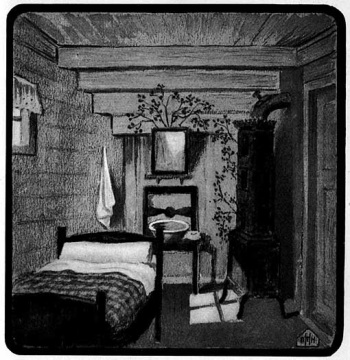
The little room, whose only furniture consisted of a bed, a chair, a stove, and a small wooden shelf with a mirror over it, was filled with daylight in spite of the early hour. The sun fell slanting down through a window set high up in the wall directly over Lisbeth's bed, and the windowpanes were pictured in bright yellow squares on the floor near the tiny stove. The corner of one square spread itself against the stove, and Lisbeth traced it with her eyes as she lay in bed. At the tip of the corner glimmered something light-green and shiny. Was it from there that a fine, wonderful fragrance came floating toward her? She sniffed a little. Yes, indeed! now she remembered. The fragrance came from the fresh birch twigs she had decorated the room with yesterday. Out of doors it was spring,—the sprouting, bursting springtime. To-day the cattle were to be let out and the calves named. To-day she would begin work in earnest and be a responsible individual. In short, she would be the herd girl at Hoel Farm.
Read the rest of
today's chapter. To
be continued next week....
(You can read the
beginning of the
story in the
archives if you
missed it.
Note that several of
the images were scavenged off the internet. Click on the image to
find its source.)
CHAPTER
3:
LEAVING PEEROUT CASTLE
 The next time Lisbeth Longfrock came to Hoel Farm, she did
not come alone; and she came—to stay!
The next time Lisbeth Longfrock came to Hoel Farm, she did
not come alone; and she came—to stay!
All that had happened between that first visit and her second coming had been far, far different from anything Lisbeth had ever imagined. It seemed as if there had been no time for her to think about the strange events while they were taking place. She did not realize what their result would be until after she had lived through them and gone out of the gate of Peerout Castle when everything was over. So much had been going on in those last sad, solemn days,—so much that was new to see and to hear,—that although she had felt a lump in her throat the whole time, she had not had a real cry until at the very end. But when she had passed through the gate that last day, and had stopped and looked back, the picture that she then saw had brought the whole clearly before her, with all its sorrow. Something was gone that would never come again. She would never again go to Peerout Castle except as a stranger. She had no home—no home anywhere. And at that she had begun to weep so bitterly that those who had been thinking how wisely and quietly she was taking her trouble could but stand and look at her in wonder.
Read the rest of today's chapter. To be continued tomorrow....
(I'm posting this a bit early
because we're going to be in town all day. You can read the
beginning of the
story in the
archives if you
missed it.
Note that several of
the images were scavenged off the internet. Click on the image to
find its source.)
CHAPTER 2: LISBETH LONGFROCK AS
SPINNING WOMAN
 When Lisbeth found herself in the farm
dooryard, with the different
buildings all about her, she really had to stand still and gaze around.
Oh, how large everything was!—quite on another scale from things at
home. Why, the barn door was so broad and high that Peerout Castle
could easily go right through it, and each windowpane in the big house
was as large as their own whole window. And such a goat!—for just then
she caught sight of Crookhorn, who had come warily up to the doorway,
and who only saw fit to draw back as Bearhunter approached. Not that
Crookhorn was afraid of Bearhunter,—no, indeed!
When Lisbeth found herself in the farm
dooryard, with the different
buildings all about her, she really had to stand still and gaze around.
Oh, how large everything was!—quite on another scale from things at
home. Why, the barn door was so broad and high that Peerout Castle
could easily go right through it, and each windowpane in the big house
was as large as their own whole window. And such a goat!—for just then
she caught sight of Crookhorn, who had come warily up to the doorway,
and who only saw fit to draw back as Bearhunter approached. Not that
Crookhorn was afraid of Bearhunter,—no, indeed!
The goat was
larger than most goats,—about as large as a good-sized
calf. If the cows belonging to Hoel Farm were as much larger than
ordinary cows, thought Lisbeth, they would be able to eat grass from
the roof of Peerout Castle while standing, just as usual, on the
ground.
She glanced searchingly at the cow-house door. No, it was not larger
than such doors usually were, so the cows were evidently no bigger than
other cows.
Read the rest of today's chapter. To be continued tomorrow....
(Read the beginning of the
story in the
archives. Note that several of
the images were scavenged off the internet. Click on the image to
find its source.)
CHAPTER
I: LISBETH LONGFROCK GOES TO
HOEL FARM

Bearhunter, the big, shaggy old dog at Hoel Farm, sat on the stone step in front of the house, looking soberly around the spacious dooryard.
It was a clear, cold winter's day toward the beginning of spring, and the sun shone brightly over the glittering snow. In spite of the bright sunshine, however, Bearhunter would have liked to be indoors much better than out, if his sense of responsibility had permitted; for his paws ached with the cold, and he had to keep holding them up one after another from the stone slab to keep from getting the "claw ache." Bearhunter did not wish to risk that, because "claw ache" is very painful, as every northern dog knows.
But to leave his post as watchman was not to be thought of just now, for the pigs and the goats were out to-day. At this moment they were busy with their separate affairs and behaving very well,—the pigs over on the sunny side of the dooryard scratching themselves against the corner of the cow house, and the goats gnawing bark from the big heap of pine branches that had been laid near the sheep barn for their special use. They looked as if they thought of nothing but their scratching and gnawing; but Bearhunter knew well, from previous experience, that no sooner would he go into the house than both pigs and goats would come rushing over to the doorway and do all the mischief they could. That big goat, Crookhorn,—the new one who had come to the farm last autumn and whom Bearhunter had not yet brought under discipline,—had already strayed in a roundabout way to the very corner of the farmhouse, and was looking at Bearhunter in a self-important manner, as if she did not fear him in the least. She was really an intolerable creature, that goat Crookhorn! But just let her dare—!
Read the rest of
today's chapter. To
be continued tomorrow....
I
dug up this open source children's story to spice up our journey
through winter. Stay tuned at lunch time every day (when I
remember) for installments of this early twentieth century Norwegian
tale. If you just can't stand the suspense, you can read the
whole thing at www.gutenberg.org.
LISBETH LONGFROCK
Translated from the Norwegian of
Hans Aanrud
BY LAURA E. POULSSON
Illustrated by Othar Holmboe
COPYRIGHT, 1907
style="font-family: Century Schoolbook L; font-weight: bold;">PREFACE
Hans Aanrud's short stories are considered by his own countrymen as belonging to the most original and artistically finished life pictures that have been produced by the younger literati of Norway. They are generally concerned with peasant character, and present in true balance the coarse and fine in peasant nature. The style of speech is occasionally over-concrete for sophisticated ears, but it is not unwholesome. Of weak or cloying sweetness—so abhorrent to Norwegian taste—there is never a trace.
Sidsel Sidsærk was dedicated to the author's daughter on her eighth birthday, and is doubtless largely reminiscent of Aanrud's own childhood. If I have been able to give a rendering at all worthy of the original, readers of Lisbeth Longfrock will find that the whole story breathes a spirit of unaffected poetry not inconsistent with the common life which it depicts. This fine blending of the poetic and commonplace is another characteristic of Aanrud's writings.
While translating the book I was living in the region where the scenes of the story are laid, and had the benefit of local knowledge concerning terms used, customs referred to, etc. No pains were spared in verifying particulars, especially through elderly people on the farms, who could best explain the old-fashioned terms and who had a clear remembrance of obsolescent details of sæter life. For this welcome help and for elucidations through other friends I wish here to offer my hearty thanks.
Being desirous of having the conditions of Norwegian farm life made as clear as possible to young English and American readers, I felt that several illustrations were necessary and that it would be well for these to be the work of a Norwegian. To understand how the sun can be already high in the heavens when it rises, and how, when it sets, the shadow of the western mountain can creep as quickly as it does from the bottom of the valley up the opposite slope, one must have some conception of the narrowness of Norwegian valleys, with steep mountain ridges on either side. I felt also that readers would be interested in pictures showing how the dooryard of a well-to-do Norwegian farm looks, how the open fireplace of the roomy kitchen differs from our fireplaces, how tall and slender a Norwegian stove is, built with alternating spaces and heat boxes, several stories high, and how Crookhorn and the billy goat appeared when about to begin their grand tussle up at Hoel Sæter.
Sidsel Sidsærk has given much pleasure to old and young. I hope that Lisbeth Longfrock may have the same good fortune.
LAURA E. POULSSON
Hopkinton, Massachusetts

Or explore more posts by date or by subject.
About us: Anna Hess and Mark Hamilton spent over a decade living self-sufficiently in the mountains of Virginia before moving north to start over from scratch in the foothills of Ohio. They've experimented with permaculture, no-till gardening, trailersteading, home-based microbusinesses and much more, writing about their adventures in both blogs and books.
Want to be notified when new comments are posted on this page? Click on the RSS button after you add a comment to subscribe to the comment feed, or simply check the box beside "email replies to me" while writing your comment.