How to help chicks during hatching
 Is
it worth it to help chicks who are having trouble getting out of the
shell? For that matter, how can you tell if they're having
trouble? If you do help, how? I'm far from an expert, but
after our second hatch, I'm starting to feel like I have a handle on
the answers to these thorny questions, so I thought I'd share.
Is
it worth it to help chicks who are having trouble getting out of the
shell? For that matter, how can you tell if they're having
trouble? If you do help, how? I'm far from an expert, but
after our second hatch, I'm starting to feel like I have a handle on
the answers to these thorny questions, so I thought I'd share.
First of all, the course
of least resistance is to not help, which is what I did with our first
hatch. If you're okay with some good chicks dying in the
incubator, this route makes sense, but you can improve your hatch rate
by giving troubled chicks a hand. That said, I wouldn't recommend
helping unless:
- You have some sort of critical care unit prepared (like a spare incubator, all warmed up.) Chicks you help out of the shell are likely to be weak and will need some extra time in a warm spot where they won't be picked on. Otherwise, your more vibrant chicks might peck them to death.
- You have a way of boosting the humidity in the incubator. Helping means opening the lid more, which can harm your currently hatching chicks. I devised an easy method of increasing the incubator humidity so that the chicks barely noticed me lifting the lid.
- You're willing to cull chicks.
The process of escaping the shell naturally kills chicks that are
damaged or are too weak to make it in life. By helping chicks out
of the shell, you're taking responsibility for euthanizing the ones
that survive but are too damaged to live in your flock. One of
the three chicks we helped had a problematic leg (not splayed legs, but
worse) that meant it would never be able to walk, and we had to put it
out of its misery. We figured out how to cull
chicks so that they die in seconds (but I'm putting the information
behind a link since I know the image will bother some of you.)
 If you aren't scared into
letting nature take its course, let's move on to when to help
chicks. In most cases, an untroubled chick will pip (peck a hole
in its shell) and then spend some time thinking about its
options. After anywhere from a few minutes to a few hours, the
chick starts hitting its beak against the shell in earnest to unzip
itself, a process that usually only takes an hour or so once
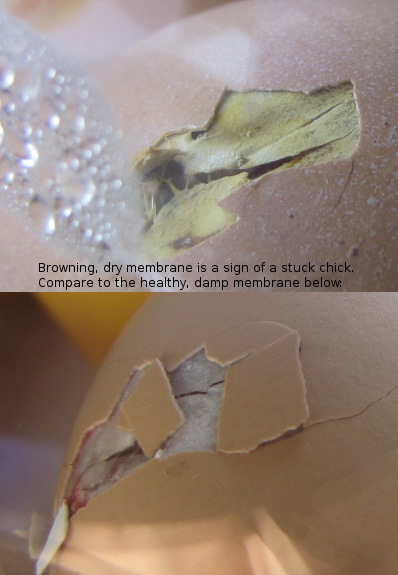
started. You can tell the chick is having trouble if it gets
stuck for several hours in the unzipping stage, either futilely banging
its beak against the hole without making further openings in the shell
or mostly unzipped but unable to kick free. A chick is also
troubled if it's pipped but hasn't started unzipping after twelve
hours, or if the bit of exposed membrane around the pipping hole is
starting to turn tan and dry. Finally, if a chick somehow
maneuvers itself so that it's trying to pip at the pointed end of the
shell, it won't be able to get out, so you might as well help from the
beginning.
If you aren't scared into
letting nature take its course, let's move on to when to help
chicks. In most cases, an untroubled chick will pip (peck a hole
in its shell) and then spend some time thinking about its
options. After anywhere from a few minutes to a few hours, the
chick starts hitting its beak against the shell in earnest to unzip
itself, a process that usually only takes an hour or so once
started. You can tell the chick is having trouble if it gets
stuck for several hours in the unzipping stage, either futilely banging
its beak against the hole without making further openings in the shell
or mostly unzipped but unable to kick free. A chick is also
troubled if it's pipped but hasn't started unzipping after twelve
hours, or if the bit of exposed membrane around the pipping hole is
starting to turn tan and dry. Finally, if a chick somehow
maneuvers itself so that it's trying to pip at the pointed end of the
shell, it won't be able to get out, so you might as well help from the
beginning.
If you have a stuck
chick, how can you help? You'll need a basin of warm water (baby
bottle temperature), a clean rag, and nimble fingers. First step
is to moisten the membranes since they've probably started to dry out
if the chick has been pipped for so long. Dampen the rag in the
warm water and encircle the egg, then squeeze a few drops of water onto
the exposed membrane around the pipping hole. Be careful not to
drown the chick, though, since its beak will be right there --- you
don't want any water to actually run into the egg, just hydrate the
membrane. Since the chick has already started a hole, it should
be pretty simple to gently pick off bits of shell and membrane, opening
up a line around the shell just like the chick would have. If
your chick is worth saving, once you get the shell separated into two
halves, it will kick its way out, which is important for development of
the chick's legs. The membrane shouldn't bleed --- if it does,
the chick isn't really quite ready to hatch, so pop it back in the
incubator. (All of this is done in a warm spot outside the
incubator, by the way. You plucked out the problematic egg and
quickly reclosed the lid to keep everyone else toasty and moist.)
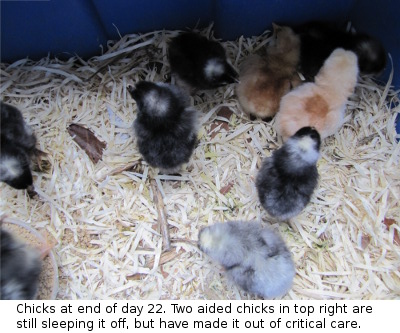 I
helped three chicks during our most recent hatch, and all three of them
would have survived if I hadn't decided to cull the chick with the
troubled leg. I'm about 95% sure all three of these chicks would
have died if I hadn't helped, so I figure the time was well
spent. Plus, I didn't have dead chicks stinking up the incubator
like I did last time around, so I was able to let it keep running clear
to the end of day 22, netting one late hatcher halfway through the last
day. I'll definitely help any ailing chicks next time.
I
helped three chicks during our most recent hatch, and all three of them
would have survived if I hadn't decided to cull the chick with the
troubled leg. I'm about 95% sure all three of these chicks would
have died if I hadn't helped, so I figure the time was well
spent. Plus, I didn't have dead chicks stinking up the incubator
like I did last time around, so I was able to let it keep running clear
to the end of day 22, netting one late hatcher halfway through the last
day. I'll definitely help any ailing chicks next time.
 Since writing this post, I've perfected my
technique of helping chicks without bothering their siblings.
I've also got a better handle on when it's a good idea to help, and
when those chicks will have to be culled. Learn more about
helping chicks out of the shell in my 99 cent ebook.
Since writing this post, I've perfected my
technique of helping chicks without bothering their siblings.
I've also got a better handle on when it's a good idea to help, and
when those chicks will have to be culled. Learn more about
helping chicks out of the shell in my 99 cent ebook.
Permaculture
Chicken: Incubation Handbook walks beginners through perfecting the
incubating and hatching process
so they can enjoy the exhilaration of the hatch without the angst of
dead chicks. 92 full color photos bring incubation to life, while
charts, diagrams, and tables provide the hard data you need to
accomplish a hatch rate of 85% or more.

Or explore more posts by date or by subject.
About us: Anna Hess and Mark Hamilton spent over a decade living self-sufficiently in the mountains of Virginia before moving north to start over from scratch in the foothills of Ohio. They've experimented with permaculture, no-till gardening, trailersteading, home-based microbusinesses and much more, writing about their adventures in both blogs and books.
Want to be notified when new comments are posted on this page? Click on the RSS button after you add a comment to subscribe to the comment feed, or simply check the box beside "email replies to me" while writing your comment.
Congrats on your new additions. I hope you didn't get your hopes up to much (counting your chickens before they hatch). I would think of this hatch as a great success. I didn't catch the final number but your hatch rate looks great. I wish I could be so lucky, although you now have me thinking that a part of my problems may be age of my girls.
Your neonatal intensive care chickens look great thanks to their c-section. I have always read to never attempt this. That it is crucial to development. I'm forced to watch as healthy looking chickens die just one crack away from freedom. But after your example, I think I will assist in the final stages next time if need be. I mean what is there to lose.
Congrats again, those are some cute chicks.
Dean --- I'm not sure how laws come into play here, but I think I agree with you? (Head's still a little fuzzy from the hatch drama, so I'm not sure I parsed your comment right.)
Erich --- I'm very happy with our hatch rate! Not quite what I hoped, but definitely massively better than the first time along. We ended up with 9 happy chicks, which is pretty good since 4 of the original eggs were infertile and don't count into our hatch rate at all. That's 45% hatch total, but 58% for the cuckoo marans who weren't hindered by old age of the parents. I figure I can reach the backyard hatcher's standard of 75% to 80% within another try or two!
I think that being willing to cull birds that really shouldn't have hatched is key if you attempt helping them. The actual helping didn't seem nearly as invasive as I thought it would be --- I didn't seem to be hurting the chicks at all. And it's just too painful to watch the chicks die when you know you can help.
Homemade in Alaska --- I think that humidity during hatch was a problem during our first time around, but this time our incubator had a gauge and I kept it around 71%. The really spunky chicks had no problem --- the reason I had to help so many is because our homegrown chicks were just less vigorous due to the age of their mothers. I'm hopeful that during our next hatch (without using our old hens' eggs), we won't need to help as much. That said, it didn't seem to hurt anything --- as of this afternoon, both of the helped chicks that I kept are still alive. Our homegrown one is still a bit tired, resting under the brooder, but the other is perky and I think they're both going to make it.
My analysis of when to help isn't really based on how long they've been pipped, but on how they're acting. If they've only pipped, but are banging their heads futilely against the shell, they're clearly trying to unzip and just aren't able to. I don't think chicks can sustain that unzipping activity for more than a few hours, so even if they haven't gotten past the pip stage in terms of hole size, I help them if they've been trying to unzip for a long time.
Not sure if it works on chickens, but I have seen this work on other birds, namely a small parrot and a turkey. The leg bones are still a little soft at birth, if the leg is not splayed out to far you can turn it (a little) and splint it. Leave it for a day or two then turn it a little more re-splinting it, if it looks like it will not work you can always put it down later. Since chickens have to be able to roost it would be a wait and see thing. About the parrot, ever so often he would fall off his perch at night. I will not describe the language he used while climbing back up to the pearch; he picked up some choice ones at my dad's garage.
Thank you so much for having this information available. I had a early pipper who got stuck in process and never zipped her shell all the way. After reading your post I assisted by zipping the shell but not the membrane and she hatched within the hour and appears to be doing well. Thank you so much
E book permaculture chicken infomration handbook. I cant get the book from Kindle although its advertised there, it says there is no pricing information how can i get it?
Here is the just of it: NEVER EVER help a chick hatch. I learned it the hard way, many a time I lost many of them because I simply could not handle my anticipation So I had the urge to throw my 2 cents, it might help some others
Reading this forum, you probably are a newbie as I am. I know how impatient you could be waiting to see the baby chick out of the shell, I know I was, and still am whenever there is a clutch in the incubator, I was also a bit afraid that would die if the hatching takes too long. You have probably read many times that you should not even open the incubator until all the chicks are out of their shells, much less help them chick hatch, it is dangerous and can often lead to bleeding & the death of the baby birds.
Here is the thing: do not worry for their safety! As long as they cracked the shell and thus they can breath, there is nowhere in the world safer for them than inside that shell.
A chick can survive without food or water for up to 3 days, add to that 1 day (because inside the shell it is not moving nor spending energy). Besides, if it did not get our yet, chances are that it did not finish absorbing its yolk yet, so add 1 more day. All in all, you can leave the chicks in their shell for up to 5 days (in most extreme cases) after they make the first crack !!!
Hope this would help some of you
Some breeds are harder to hatch than others. Especially after cold winter in the coop(we live near Canada where temps reach 20 below for weeks) getting oyster shell as a supplement. Makes for thicker/harder shells. Larger breeds like Rhode reds jersey giants chicks often need a little assist. We've helped zip and break outs of distressed chicks. If you still see bloody membranes we've wrapped the 1/4 opened egg with warm damp paper towels to keep them moist(not directly on chick) back into the incubator they go. eventually they roll them selves out when ready. There are ways of resolving many leg issues for chicks that have been in too long using pipe cleaners and forming braces(crooked toes etc) Below is a add for poop free water.Chickens are naturally adapted to drinking from puddles lakes ponds and streams. My older birds had a hard time w/ drip line. As babies they drank from the bell. I 've made my own trouble free watering system using a toilet flush valve and cat litter pale ( like what fresh step comes in w/ plastic lid) Cutting the end off & stuffing the 3/8 supply line into a garden hose cutting a hole in bottom of pail opening up the sides for access. Lid keeps chicks from messing in water.The whole thing cost me $15. I may have to clean it once a month as fresh water is added when low(flush valve) If it's too tall toss a rock next to it.