
Chainsaw sharpening
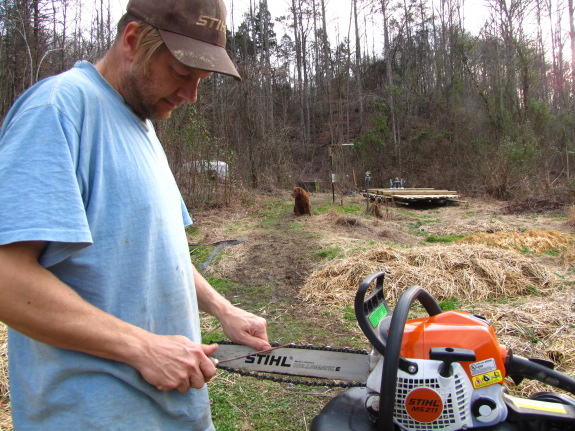
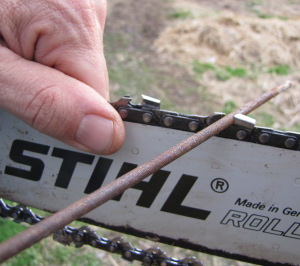 I like to use a round file without
the guide piece attached.
I like to use a round file without
the guide piece attached.
There are several different size
files you can get, and it's important to have the right diameter.
My method involves pushing
the file with pressure from the short side of the angle towards the
long end. When pulling back reduce the pressure and repeat until the
resistance feels smooth.
It should only take a few
strokes to do each tooth. Some people will say to twist a little while
you're pushing. Easier said than done. I've found that rotating the
file after each tooth helps spread the wear more evenly. Replace the
file once the grooves get worn down. I think one will usually last me
somewhere around 10 to 15 sharpenings.

Or explore more posts by date or by subject.
About us: Anna Hess and Mark Hamilton spent over a decade living self-sufficiently in the mountains of Virginia before moving north to start over from scratch in the foothills of Ohio. They've experimented with permaculture, no-till gardening, trailersteading, home-based microbusinesses and much more, writing about their adventures in both blogs and books.
Want to be notified when new comments are posted on this page? Click on the RSS button after you add a comment to subscribe to the comment feed, or simply check the box beside "email replies to me" while writing your comment.
Your file looks quite rusty in the pictures. Files are usually made from high-carbon steel which is quite prone to rusting if stored in a humid environment. Rust will degrade the file's performance because it tends to round the sharp edges that do the actual filing.
An old trick it to rub a candle on the file before using it. It will make the filing easier and prevent the file's grooves from clogging. It might even prevent rusting somewhat.
A ceramic file won't rust and performs well even on hardened steel. A diamond-grit coated file also works well on hard materials.
You also need a flat file for the rakers on the chain. After several sharpenings, the raker will be higher than the cutter. Stihl makes a good kit that includes a file guide for the rakers.
The great thing about Stihl chains is the angle mark on the cutters. Helps maintain the correct sharpening angle.
Roland-You are right, the file I'm using is somewhat rusted and ready to be replaced. Never heard of the candle wax trick or a file made from ceramic. Now I'm wondering if it would be cheaper to pay more for a ceramic version compared to multiple replacements of a regular file?
Bob-I almost forgot about those angle marks. Thanks for the inspiration for todays post...and yes, I should say something about the rakers...maybe I can work that into the next post.
The reason why your files wear out so quickly is probably that both the file and the cutting bits on the chainsaw are hardened steel, and the file is not much harder than the chain.
I've got a silicon carbide snife sharpener that I've been using for at least two decades with no visible signs of wear on the carbide bits.
Ceramic files should last much longer as it is a lot harder than steel. But as opposed to hardened steel which typically has a hard surface and a less hard but more flexible core, ceramics are hard through and through. That also makes them more brittle. Ceramics will not deform plastically when overloaded like steel can do, they will just break. So if you put a ceramic file in a vise, and give it a good whack with a hamer, you might be able to break it. So don't try to use a ceramic file like this as a pry-bar. But if you look at youtube videos of machining steel with mills with ceramic inserts, it is not uncommon to see literally red-hot swarf (chips) coming off, so it cuts steel really well.
In the picture you are fileing the cutter backwards. The file should go from the inside of the cutter towards the outside. The cutters will sharpen easier, the file will last longer, and the cutters will be sharper when you are finished. If you are using full chisel chain, you sharpen until the cutting edge disappears (you can no longer see it). The file will leave a slight burr all along the cutting edge, but that burr will wear off within the first few seconds of use.
There's no need for ceramic files or anything special. There are some junk files out there that dull quickly. Stihl files seem to last pretty good. I'm sure that there are some other good ones as well. I've never had a file get rusty on me. My files stay in a small, cheap tool box that gets snow thrown in it about ever time I cut firewood, and then sits in the hot humid garage all summer. I've seen some files rust after sitting around for years, but never one that gets used with any regularity. Not sure what's going on there.