Building a bee waterer
 We're still feeding
our honeybees, helping them sock away some extra honey to make it
through the winter. I've been giving them really strong sugar
water (half sugar, half water) to make it easier for them to dehydrate
the liquid into honey in the cool weather, but that seems to make the
bees
exceptionally thirsty. At the same time, I poured out our kiddie
pool of water since it's too late in the year to be soaking
mushrooms. The combination of factors sent the bees searching for
other water sources, and we started finding drowned bees in every
standing body of water around the farm.
We're still feeding
our honeybees, helping them sock away some extra honey to make it
through the winter. I've been giving them really strong sugar
water (half sugar, half water) to make it easier for them to dehydrate
the liquid into honey in the cool weather, but that seems to make the
bees
exceptionally thirsty. At the same time, I poured out our kiddie
pool of water since it's too late in the year to be soaking
mushrooms. The combination of factors sent the bees searching for
other water sources, and we started finding drowned bees in every
standing body of water around the farm.
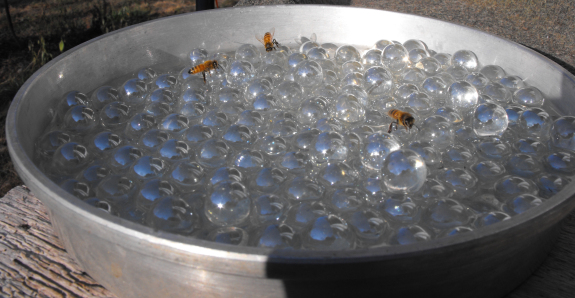
Guilt-stricken, I set up a water feeder by filling a pie pan with
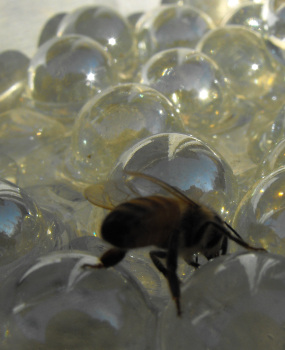
marbles and then water. The marbles give the bees a spot to land
so that they don't drown when they come to drink, and the bees were
suitably impressed. No more drowned bees!

Or explore more posts by date or by subject.
About us: Anna Hess and Mark Hamilton spent over a decade living self-sufficiently in the mountains of Virginia before moving north to start over from scratch in the foothills of Ohio. They've experimented with permaculture, no-till gardening, trailersteading, home-based microbusinesses and much more, writing about their adventures in both blogs and books.
Want to be notified when new comments are posted on this page? Click on the RSS button after you add a comment to subscribe to the comment feed, or simply check the box beside "email replies to me" while writing your comment.
My favorite way is to use an empty Mason jar, remove the cap, fill the jar with sugar water (4 table spoon of sugar for each 2 ounce of water completely dissolved), cover it with napkin already folded twice, then cover it with a plate. Inverse the whole thing and leave it on a table out there.
If you insert a small pin or needle between the jar and napkin, it will allow more juicy water out while still control the flow.
I actually am doing that with hummingbird feeders I make the nectar myself I have 3 out. I had so many one day they covered them got what they wanted drained all 3 and went on their merry way. I love the bee waterer I was wondering about that. I will do this also as I am watering the birds with a sturdy plastic bowl hammered into a fence post near the feeder. I placed a rock in the deep bowl (small) so the birds that are small will not drown as they get a drink they can stand on the rock as they drink. The water effect! I love it! We are Native American me and my husband and we love your site. We love and honor Mother Earth and the Creators animals. S'gi (thank you)
Utsati Adadoligi (Many Blessings) Meli (Mary)
Everybody --- Fun to see so many of you dropping by this old post!
To be honest, I didn't leave the waterer out long enough to really test whether it would get mosquito problems. After a week or so, I needed my cake pan back --- we can only go so long without deep dish pies. But I didn't see any larvae during that time, despite not cleaning it, which makes me suspect that since there's no real standing water, the mosquitoes didn't parse this as a safe place to lay their eggs. I'll be curious to hear from anyone who tries and does or doesn't get mosquito larvae in their waterer.
Sheila --- These are glass marbles, from the exact same spot Trish mentions below.
Sugar water sounded like a great idea but was concerned about the sugar so did a bit of reading and gleaned enough to realize that if bees need sugar water then the keepers will do it and only under certain circumstances. Nature lovers want to help but there are times we need to be careful.
http://forums.gardenweb.com/forums/load/bees/msg1000290222908.html
I picked up a 5 gallon plastic. food-grade pail, (courtesy of our local donut shop) filled it with water and floated several dozen real styrofoam packing peanuts on the surface for the bees to land on.
3
To make it easier for the girls to climb out, lean a straight stick or board from inside the corner of the bucket and they can climb back out and fly away.
Evan --- I really like your alternative! Very simple and cheap, and uses up those ubiquitous packing peanuts....
James --- Now and then, as a beekeeper, you have to feed the bees sugar water. For example, a new package needs some food before they've got their feet under them enough to forage for their own, and you sometimes have to feed them after a drought so they'll stock up enough honey for the winter. But I wouldn't do it if I didn't keep bees and know the state of the hive.
When several large Banks Roses were removed from close to a brick wall, I discovered that I had bees "living" in the space between bricks in the wall behind my house. There were hundreds on either side of the wall around the one space during spring......an increase over several months from winter. The Rosemary bushes attracted them, as did a few other plants. I've had them buzzing around those bushes for years w never a problem, they never bothered me as I worked in the yard amongst the bushes---I did talk to them tho! Anyway, after 3 weeks out of town, they were mostly gone upon my return...now summer is here with it's horrendous heat in the 100's---So. NV. I have a pool, tho see no drowned bees.
I'm wondering if I should make a bee waterer in the hopes that they will return. Maybe they've gone elsewhere? ps..I have photos of the bees when the mound on either side of the wall was about 2-3 thick of bees all group together---it was fascinating & a bit intimidating at the same time!
Midge --- We haven't noticed wasps at our bee waterer, but you probably would if you followed one of the recommendations in the comments of using sugar water. With plain water, we seem to only attract honeybees.
On the other hand, I like wasps. They do have a painful sting, but don't seem to harass me unless I accidentally squash one. And in the meantime, wasps do a great job of ridding the garden of pest insects. Don't forget, wasps have a use too!
Our beekeepers guild recommends floating champagne or wine corks in a bucket of water or bowl etc. It's a better surface for honeybees to get traction on with their little legs. If you use old corks, cut off the wine stained section so they are "clean" corks.
I admit your version is a very pretty option though.
Now I know what to do with the various marbles and such I cant bring myself to just throw out. I wonder if it matters what color they are or will the bees just figure out where the water is? I'm sure that if you replace the water even every couple of days it wont matter if skeeters lay eggs, it takes some time for them to even hatch and the water will be changed by them. My guess is that problem will be more that they will dry out quickly and you would have to keep an eye on it to keep it supplied.
A stupid question I am sure, but I must inquire. The sugar used is all natural, organic sugar cane, yes? no?
The poop-free water jug is wonderful also.
A stupid question I am sure, but I must inquire. The sugar used is all natural, organic sugar cane, yes? no?
The poop-free water jug is wonderful also.
Really loved this idea i used marbles with color. I'm not sure if it made a difference but i think to the bees the bright colors might have attracted them
Thanks for the good idea
I had actually considered this! I think it's an excellent idea, HOWEVER, I would caution you all to look for glass marbles without any kind of iridescent paint on them (as those pictured). Who knows what kind of paint is used on them and lead could be an issue, not to mention other contaminants.
Someone asked about what to do about ants on the waterer and also on the hummingbird feeders. I would put a circle of liquid dish detergent around the waterer, or if you put the waterer on a pole, put it on the pole. I use this on the wire that holds my hummingbird feeder and on the cap where it attaches and the ants will NOT cross over it.
Megan, get one of those spigots that dogs lick when they want water. No refilling bowls or drown bees: http://www.amazon.com/Lixit-Original-Dog-Faucet-Waterer/dp/B0002UOIZG/ref=sr_1_1?ie=UTF8&qid=1395937984&sr=8-1&keywords=water+spigot+dog
Also, I have read about making contraptions to provide water for butterflies. Put out a terracotta saucer with sand in it and add water. They stand on the sand and take in the water. I am wondering if this marble idea would encourage mosquito breeding. We have a problem with that.
Narde (and others) --- Actually, this waterer is envisioned to be just a waterer, not a feeder, so no sugar at all is included. In the summer, honeybees often need sources of water they won't drown in, and this fits the bill.
I'm not sure I'd recommend feeding bees unless you were a beekeeper and knew they needed it. If you do feed, you want to use plain white cane sugar --- even though beet sugar and brown sugar may be better choices for people, they're not good for bees. Organic, of course, is better, but probably isn't essential.
Brenda --- Colored marbles are a great idea! As long as the color is embedded in the glass, not a coating on the outside.
Meaghan --- If you just use water (no sugar), there will be no ants involved.
Hi,
this is very nice to have. But, can I also use the coloured marbels? I just can't find the celar ones. Thanks, Maja
This morning I opened up my curtains to my little backyard to discover DOZENS of honey bees around our little kiddie pool. Many of them had already died trying to get water:( There were many hanging on the side of the pool trying to get a drink without falling in but the majority of the bees were taking turns landing on this little 3" pelican pool toy so that they could get close enough to get a drink. I had hurried outside to rescue the ones that had landed in the pool and couldn't get back out...proud to say I saved 4 bees! I stood there trying to figure a way to attract them to another spot where they could safely get water without drownding and get them away from the pool (I don't think having bees in the pool would go over well with the toddlers that use it...lol) so I got on the computer for ideas and THANK YOU! I happend to have a pie plate and a bag of blue/aqua/white glass mosaic marbles I hadn't used for anything yet. So I did the 3:1 ratio of water and shook it up in a mason jar and went outside with my expirement. At first, no matter how hard I tried I couldn't get the bees to notice the pie plate. So we carefully got a large strainer-and moved the pelican squirt toy to the pie plate, and soon, one by one the bees started to get the idea. I went back into the house to observe from my bedroom and I could tell which were returning bees-they would go straight for the pie plate while the new bees hovered around the pool until they saw the other bees happily getting re-energized at their new "bee watering station" Thank you so much!
Michelle
Thank you so much!
Michelle
http://www.waldeneffect.org/blog/Building_a_bee_waterer/
I just read on a nature Facebook page that (Hilton Pond Center...) that beekeepers use a certain % of sugar to water. You may wish to visit the or ask a beekeeper what ratio sugar to water to use.
Just wrote you about this a minute ago:
Here is the link -- if you read the comments to this video, especially those by Hilton Pond you can find the ratio beekeepers use of water to sugar.
https://www.facebook.com/HiltonPond/?fref=ts
PS Never feed hummers honey. Not that you would.
Hi Love the idea of the coloured marbles in the bowl with the water. I have just been using water and stones in my bowl. I have a question. I have a community garden plot. The bees drink it down quickly in the hot weather. I have another bowl at home I used for crafts before. I could have two bowls there. Does anyone know anything about benzoin. I used this when making salt dough sachets. All the ingredients went into a bowl and then you roll it out and cut it with a cookie cutter. One of the ingredients in the bowl was benzoin. It has been washed, but does anyone know if the bowl is safe to use for the bees or should I toss it. Thanks.
Please don't add sugar or honey to the water. If the bees get nourishment from your sweetened water, they won't pollinate the flowers. Also - honey can lead to the destruction of entire hives.
Honey can contain spores of a bacteria called Paenibacillus which causes AFD (American Foulbrood Disease). It is deadly to bees. The bees will take the honey back to their hive and if it contains the pathogen it is likely to infect the entire hive.
https://www.intelligentliving.co/make-bee-waterer-help-hydrate-pollinators/