
Behind the scenes at Seed Savers Exchange
 I didn't contact Seed Savers
Exchange about my potentially
bad tomato seeds
because I wasn't 100% sure the problem was their fault. But one
of their employee's --- Tom Wahlberg --- stumbled across my post and
emailed me in concern. He told me that, "like we state on each
packet, we really do mean Satisfaction Guaranteed, and have credited
your account for these two packets."
I didn't contact Seed Savers
Exchange about my potentially
bad tomato seeds
because I wasn't 100% sure the problem was their fault. But one
of their employee's --- Tom Wahlberg --- stumbled across my post and
emailed me in concern. He told me that, "like we state on each
packet, we really do mean Satisfaction Guaranteed, and have credited
your account for these two packets."
While the refund was
appreciated, I was more intrigued to hear about how Seed Savers
Exchange grows, processes, and tests seeds. Wahlberg explained:
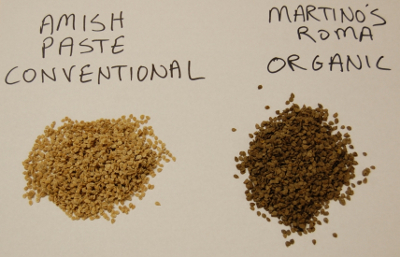
We had both of these varieties grown on
contract, one Conventional (Amish Paste) and one Organic (Martino's
Roma). The Organic tomatoes will have been processed via fermentation
technique, and will tend to retain more of the fruit's organic matter
than the Conventional.
 Depending on the length of time
of fermentation it is possible the Organic would have a higher level of
fungal activity, but also would retain more of the normal fuzzy
exterior which could also be what you are seeing. The
Conventional by contrast will have been processed via acid extraction,
which is not a seed treatment, but rather a method commercial growers use to break down the
gelatinous membrane around the seed without the delay inherent with the
fermentation process. That would also explain the difference in
the shade between the two varieties.
Depending on the length of time
of fermentation it is possible the Organic would have a higher level of
fungal activity, but also would retain more of the normal fuzzy
exterior which could also be what you are seeing. The
Conventional by contrast will have been processed via acid extraction,
which is not a seed treatment, but rather a method commercial growers use to break down the
gelatinous membrane around the seed without the delay inherent with the
fermentation process. That would also explain the difference in
the shade between the two varieties.
As for germination, we utilize Midwest Seed Services for independent analysis, and the most recent results are as follows:
Depending on the length of time
of fermentation it is possible the Organic would have a higher level of
fungal activity, but also would retain more of the normal fuzzy
exterior which could also be what you are seeing. The
Conventional by contrast will have been processed via acid extraction,
which is not a seed treatment, but rather a method commercial growers use to break down the
gelatinous membrane around the seed without the delay inherent with the
fermentation process. That would also explain the difference in
the shade between the two varieties.As for germination, we utilize Midwest Seed Services for independent analysis, and the most recent results are as follows:
| Variety |
Date of test |
Germination |
Lot# |
| Amish Paste --- Conventional |
01/12 |
96% |
107-1824 |
| Amish Paste --- Conventional |
02/12 |
98% |
107-1911 |
| Martino's Roma --- Organic |
11/11 |
96% | OG259-381 |
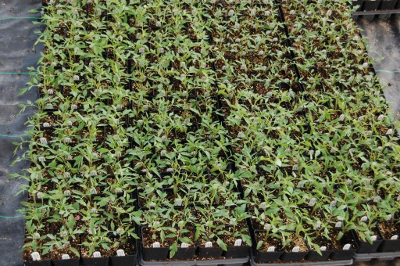
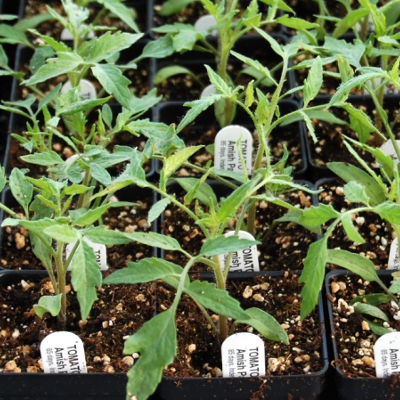 Wahlberg went on to
tell me that Seed Savers Exchange has started hundreds of Amish Paste
plants in the greenhouse this year (some of which you can see in this
and the previous photo). "In light of your observations, we will
also start a flat of the Martino's for evaluation."
Wahlberg went on to
tell me that Seed Savers Exchange has started hundreds of Amish Paste
plants in the greenhouse this year (some of which you can see in this
and the previous photo). "In light of your observations, we will
also start a flat of the Martino's for evaluation."He finished by telling me:
I'll
let you know what we find out with the Martino's flat we are
planting. Sometimes there definitely is a problem with seed
quality, but we hope through our own safeguards (field inspections,
trial plots, testing, etc) to have that be our problem, not the
customer's.
I thought I should set the record straight, and will let you know what Wahlberg finds out about the Martino's Roma seeds.

Or explore more posts by date or by subject.
About us: Anna Hess and Mark Hamilton spent over a decade living self-sufficiently in the mountains of Virginia before moving north to start over from scratch in the foothills of Ohio. They've experimented with permaculture, no-till gardening, trailersteading, home-based microbusinesses and much more, writing about their adventures in both blogs and books.
Want to be notified when new comments are posted on this page? Click on the RSS button after you add a comment to subscribe to the comment feed, or simply check the box beside "email replies to me" while writing your comment.
Anna,
Thanks for the update on the tomato seeds.
The insights into the saving and testing methods at SSE are valuable. I didn't know that commercial growers used an acid extraction process.
RDG --- I found the seed processing techniques interesting too, which is why I made the followup post.
Cindy --- Seed Savers Exchange is www.seedsavers.org.
With both in-house growing tests and independant germination testing, it seems to me that Seed Savers has good quality control.
What you should ask them is to check the germination rates on the batches of seeds you used. I'm assuming the batch numbers are printed on the packages.
This is also a good example of why alost everything that is produced commercially has a batch or serial number; so one can backtrace quality issues.
Roland --- I would have run a germination test of my own, but I'd used up all the seeds in the worst offender's packet (and composted the packet, so I didn't have the batch number, etc.) However, the employee I emailed with had my order in front of him, and I'm assuming he sent me the germination test data for the specific batch numbers I ordered from.
I'm very impressed with their growing tests and germination control too!