Introduction to permaculture lectures
 As
I mentioned yesterday,
I'm trying out Will Hooker's free online
permaculture class. The course was originally taught once a week,
with each day's lecture cut in half and put on the web in two
pieces. Since it makes sense to review and react to each pair of
lectures together, this post contains my take on lectures 1 and 2.
As
I mentioned yesterday,
I'm trying out Will Hooker's free online
permaculture class. The course was originally taught once a week,
with each day's lecture cut in half and put on the web in two
pieces. Since it makes sense to review and react to each pair of
lectures together, this post contains my take on lectures 1 and 2.
First of all, our
internet was running terribly slowly when I started
listening, which made it painful to jump to a spot in a video if I got
interrupted partway through. Luckily, the university didn't
protect against visitors simply right-clicking and saving each video to
their
computers, so I recommend you do that first. After downloading,
it'll be easy to skip past all of the information that's really only
relevant to local students --- like the getting-to-know you half hour
that made up most of lesson 1. In fact, if you know anything at
all about permaculture you might skip lesson 1 entirely and maybe even
lesson 2 (which covers permaculture ethics and principles). The
only really interesting tidbit I took away from these two lessons is
the idea of adding bird perches to the tops of
garden-trellis-and-staking posts to make it easier for our feathered
friends to hang out
and deposit manure below.
Your homework before delving into lesson three includes:
- In Grave Danger of Falling Food --- This 50 minute video about Bill Mollison is interesting, but drags a bit, especially since you're likely to have heard everything he's talking about before. It's intriguing, though, to hear permaculture-related stances straight from the horse's mouth, and to guess how current-day forest gardening grew out of Mollison's mixed-species garden.
- Earth Day Ecological Footprint Quiz and Carbon Footprint Quiz --- These quizzes are fun, but suffer from a very narrow worldview. I can understand why they don't give you the option to say you use a composting toilet and why they can't delve into the complexities of when meat-eating makes sense, but how hard would it be to let you input your actual electricity usage per year?
- Gaia's
Garden chapters 1 and 2 and Introduction
to Permaculture
chapter 1 --- These
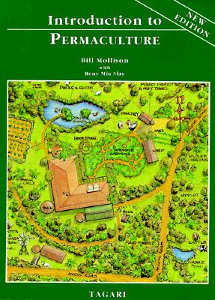 two
books are the required texts for the course
(with other books offering optional reading). I skimmed both of
these books when I first got started with permaculture many moons ago,
but recent reading (with a more experienced eye) changed my
review of each
dramatically. Now that I've tried a lot of permaculture
techniques on the ground, I find parts of Gaia's Garden naive and
overly enthusiastic, plus the book is obviously geared towards rich
suburban Americans who don't really need to grow any of their own
food. On the other hand, Bill Mollison's Introduction to Permaculture
has improved with age, and I can't quite figure out why such an
excellent book is out of print. Sure, it's based in subtropical
and tropical Australia, so you have to use completely different plants
than Mollison recommends, but the underlying themes are thoughtful and
rooted in experience (and the drawings are beautiful and informative).
two
books are the required texts for the course
(with other books offering optional reading). I skimmed both of
these books when I first got started with permaculture many moons ago,
but recent reading (with a more experienced eye) changed my
review of each
dramatically. Now that I've tried a lot of permaculture
techniques on the ground, I find parts of Gaia's Garden naive and
overly enthusiastic, plus the book is obviously geared towards rich
suburban Americans who don't really need to grow any of their own
food. On the other hand, Bill Mollison's Introduction to Permaculture
has improved with age, and I can't quite figure out why such an
excellent book is out of print. Sure, it's based in subtropical
and tropical Australia, so you have to use completely different plants
than Mollison recommends, but the underlying themes are thoughtful and
rooted in experience (and the drawings are beautiful and informative).
I'll write more
specifics about the reading when I listen to the relevant lectures (3
and 4). That post probably won't show up here until next week, so
you've got plenty of time to catch up if you want to join this year's
version of last
summer's book club.
The more the merrier!
Or explore more posts by date or by subject.
About us: Anna Hess and Mark Hamilton spent over a decade living self-sufficiently in the mountains of Virginia before moving north to start over from scratch in the foothills of Ohio. They've experimented with permaculture, no-till gardening, trailersteading, home-based microbusinesses and much more, writing about their adventures in both blogs and books.
Want to be notified when new comments are posted on this page? Click on the RSS button after you add a comment to subscribe to the comment feed, or simply check the box beside "email replies to me" while writing your comment.
There is a new -to me- webpage that lets you save YouTube videos (and some others) in resolutions higher or lower than the default. The easiest way is to add 'ss' in front of Youtube in the url. http://www.youtube.com/watch?v=CjWaP0iQmWw becomes http://www.ssyoutube.com/watch?v=CjWaP0iQmWw http://www.ssyoutube.com/watch?v=CjWaP0iQmWw
I have found it quite useful with my finicky internet connection.
Feel free to delete if this feels too spammy I have no affiliation.
This'd be real cool to watch. I wasnt able to access them on my ($&#%*+{) ipad,but will try on the pc and see if that works.
On a totally random note. Something was really eating up my cabbage. I suspected cabbage loopers, though I absolutely could not find any. However, the cabbage were being devastated, so I had to do something. , a search for remedies brought me an old farmer's way of dealing with these- i just dusted the cabbage with flour, plain ol' flour. Supposedly, the worms eat the flour, bloat up and die ( it actually has a similar effect on me). It worked! No more damage and the. Cabbage are recovering really quickly.
Thanks for spreading the word about this course--I'm looking forward to it! I agree there's not much meat in the first couple lectures, but I was glad to see the course will cover more than just gardening. I'm very much just starting to learn about permaculture, but for some reason I had in my mind it was mostly about growing plants and a few animals. It's great that energy and building design are also included!
A note on the bird perches: in places where birds frequently land, they can sometimes deposit weed seeds along with their manure. Around my parents' house, for example, a new patch of poison ivy will occasionally take hold in a flower bed because some birds like to eat the poison ivy berries. For the most part, though, the bonus fertilization is the main effect.
Just an FYI. I have been watching these lectures and I have found the RSS feed to be better for accessing because it doesn't reset to lecture one each time I visit. As it has links directly to the video files you should be able to access it from any system.
http://courses.ncsu.edu/hs432/common/podcasts/rss.xml
Sorry to turn this into a tech heavy response, but...
I am not sure how iceweasel displays and XML file. I use Firefox (also on Linux) and it makes it all nice and formatted:
With the first and last lines being links to the MP4 file. If your browser doesn't pasre the file you probably get a bunch of raw XML code with like something like:
If that is the case you would have to read through and look for lines like the following:
http://courses.ncsu.edu/hs432/common/media/01/HS432Lct1.mp4
You might also like to use a RSS reader instead and it will parse, display and often even download for you. On Linux I like to use RSSOwl. It is how I keep up with all my blogs (especailly this one )
)
Any semi-modern OS should be able to place MP4 files. I like to use VLC, personally as it play just about anything and run on just about every OS.